


When people talk about the next wave of construction in Ireland, attention usually goes to the same places.
Housing. Dublin. Data centres. Pharmaceutical projects. Major infrastructure.
But one of the more interesting construction pipelines announced in 2026 could take work in a very different direction.
In September, almost 120 projects across every local authority area in Ireland were included in the new Towns and Cities Regeneration Investment Fund, with up to €409 million available for their delivery.
Rather than one enormous project creating a concentrated spike in demand, this is investment spread across towns and cities throughout the country.
And for construction professionals, that distinction matters.
It could mean opportunities emerging in places that haven't necessarily been associated with Ireland's biggest construction pipelines and a wider mix of public realm, civil engineering, refurbishment, community and urban regeneration work.
So, where could demand start appearing?
First, what is the €409m regeneration fund?
The Towns and Cities Regeneration Investment Fund (TCRIF) replaces the Urban Regeneration and Development Fund and is designed to support the regeneration of Irish towns and cities.
The first round covers almost 120 projects across every local authority area, with investment aimed at areas including vacant and underused sites, public spaces, community facilities and civic infrastructure.
There are two important categories.
Category 1A supports projects that are earlier in their development and expected to progress over the longer term.
Category 1B is much more immediate from a construction perspective. These projects are intended to be capable of getting on site by September 2027, with individual projects eligible for significant shared funding.
That means this isn't simply a collection of long-term aspirations.
Part of the pipeline is already being positioned towards construction.
Why this matters for the Irish construction market
The headline number €409 million naturally attracts attention.
But arguably the more important detail is where the money is going and what is being built.
Ireland's construction market isn't one single market.
Someone working on a residential development in Dublin can have a very different career and local job market from someone working in Galway, Meath, Wexford or the Midlands.
Large national investment programmes can therefore become particularly interesting when spending isn't concentrated in one location.
Take Wexford.
More than €18 million has been allocated across four projects, including €9 million for the Enniscorthy Town Centre First Regeneration Project – Phase 1 and another €9 million for the John Street Urban Revival Project in New Ross.
In Meath, projects include Trimgate Street pedestrianisation in Navan and the Ratoath Civic Centre, alongside longer-term plans elsewhere in Navan and Trim.
And this pattern repeats around the country.
It starts to create something construction professionals should pay attention to:
lots of smaller and medium-sized pipelines developing at the same time.
Galway shows just how varied the work could become
Look at the projects progressing across Galway and you quickly see why "regeneration" shouldn't be interpreted as one type of construction.
In Tuam, €3.6 million has been allocated to the Shambles Outdoor Market and Event Space.
In Ballinasloe, approximately €3.7 million is allocated to the St Michael's Square Public Realm Enhancement.
In Galway City, the Ceannt–Augustine Public Realm project has been allocated €7.5 million, while another €7.5 million is allocated to An Tús Kingston Park. There is also funding connected with an eco park near Oranmore Train Station.
Within one region, you already have public realm, community, recreational and urban infrastructure projects.
That variety matters because the skills required to deliver regeneration projects can be broader than people initially expect.
This isn't only a Dublin construction story
Dublin will continue to account for a significant amount of construction activity.
But the regeneration programme adds another layer to the market.
The Midlands, for example, has more than €34 million allocated across projects involving Longford, Westmeath, Offaly and Laois.
Waterford has €22.65 million allocated across three projects: the Waterford Cultural Quarter Creative project, 22 Lady Lane and the Dungarvan Innovation and Enterprise Hub.
Wexford has projects progressing in Enniscorthy, New Ross and Wexford Town.
Galway's pipeline reaches Tuam, Ballinasloe, Oranmore and Galway City.
There are projects progressing elsewhere across the country too.
For construction professionals, that raises an interesting possibility.
The next good career opportunity might not require moving towards Ireland's biggest construction markets.
More work could gradually start moving towards them.
What types of construction professionals could benefit?
It is too early to say that every approved project will translate directly into immediate recruitment. Projects still need to move through their individual design, procurement and delivery stages.
But the nature of the programme gives us a useful indication of the skills that could become important.
Public realm and regeneration projects can require Site Engineers and Civil Engineers for roads, drainage, utilities, streetscape works and other infrastructure.
As projects move into construction, Site Managers, Project Managers and Contracts Managers may be needed to coordinate delivery.
Quantity Surveyors and commercial professionals will have an important role around procurement, cost management, variations and project controls.
There will also be requirements around Health & Safety, particularly where construction is taking place within existing town centres and busy public environments.
Then there are the specialist skills.
Heritage buildings. Refurbishment. Landscaping. Utilities. Sustainable transport. Public realm. Building upgrades.
A regeneration pipeline doesn't create demand in one neat category.
It creates overlapping pockets of demand.
The projects to watch first
Not every one of the almost 120 projects is at the same stage.
That is important.
A €150,000 allocation for planning and project development shouldn't be treated in the same way as several million euro being allocated towards a construction-ready scheme.
The projects worth watching most closely in the shorter term are therefore the Category 1B projects.
They are specifically aimed at shorter-term delivery and are expected to be capable of reaching site by September 2027.
We are already beginning to see what that progression could look like.
In September 2026, a procurement notice relating to Clonmel Town Centre sought an architect-led multidisciplinary design team to progress public realm and associated projects through detailed design, tender, construction and handover. The proposed work can include public realm, civil engineering, landscape and upgrades to protected or heritage structures, with projects anticipated to draw on TCRIF funding.
That is where a funding announcement begins becoming much more relevant to the construction market.
Funding leads to design.
Design leads to procurement.
Procurement leads to contractors.
And eventually, contractors need people
Could regional construction careers become more attractive?
This could be one of the more interesting longer-term consequences.
For many construction professionals, career decisions involve a compromise between project quality, salary, progression and location.
A strong opportunity might exist but it could involve a long commute.
A major project might provide valuable experience but require working away from home.
A regional market might offer the lifestyle someone wants but not enough project choice.
More regional investment doesn't remove those compromises overnight.
But it can change the calculation.
If towns such as Navan, Enniscorthy, New Ross, Ballinasloe, Tuam and Dungarvan develop stronger construction pipelines alongside projects already happening in their surrounding regions, professionals may gradually have more options without automatically looking towards Dublin or relocating elsewhere.
That could become particularly relevant for experienced construction professionals who value working closer to home without sacrificing the quality of projects they work on.
Contractors should be watching this pipeline too
The opportunity isn't limited to candidates.
For Ireland's medium-sized contractors, civil engineering companies and specialist subcontractors, a geographically distributed programme can open a different type of pipeline.
Not every contractor needs a €200 million project.
A series of €3 million, €5 million or €9 million public projects across several counties can be significant particularly for businesses with strong regional delivery capabilities.
And because regeneration programmes often involve existing streets, buildings and communities, contractors with experience in live environments, public works, civil infrastructure, refurbishment and complex phased construction may find their experience increasingly relevant.
€409m is the headline. The map behind it is the bigger story
One announcement doesn't mean 119 construction sites will suddenly appear around Ireland.
Some projects are further advanced than others. Some still require design and planning. Timelines can change, and funding availability remains linked to local authorities meeting the targets attached to their applications.
But that's exactly why this pipeline is worth watching now rather than when every project reaches construction.
The Irish construction market of the next few years won't only be shaped by the largest housing developments, data centres, pharmaceutical plants and infrastructure programmes.
It will also be shaped by dozens of smaller projects happening simultaneously in towns and cities around the country.
For construction professionals, the question therefore isn't simply:
Where are the biggest projects?
It may increasingly be:
What's coming next in my region?
Because with almost 120 regeneration projects and up to €409 million potentially moving through Ireland's towns and cities, some of the country's most interesting areas of future construction demand may be closer to home than people expect.
Get in Touch
Want to find out how we can help your business grow? Get in touch with us by sending a message through this form!Related Articles
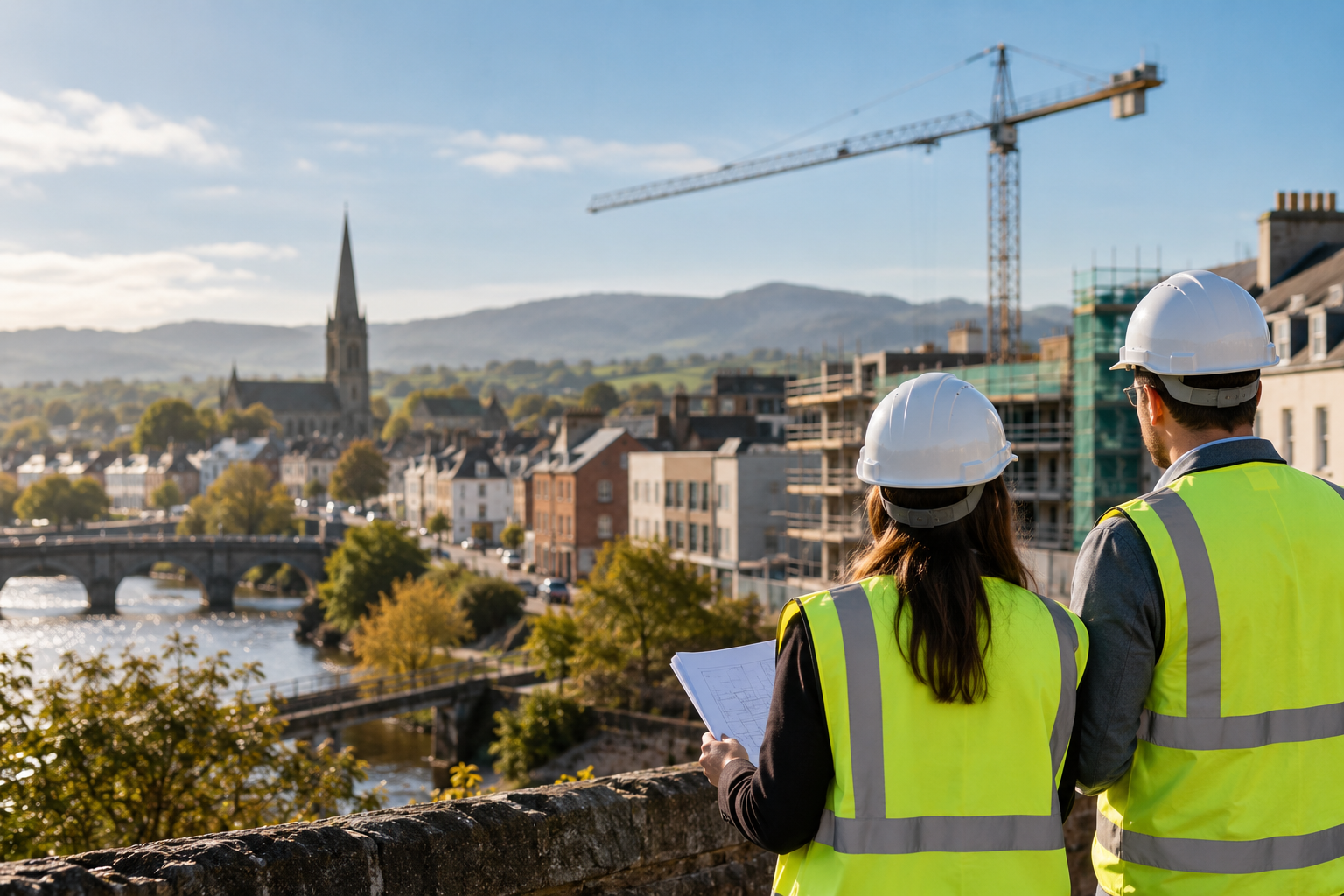
119 Irish Regeneration Projects: Where Regional Construction Demand Could Grow Next
When people talk about the next wave of construction in Ireland, attention usually goes to the same places. Housing. Dublin. Data centres. Pharmaceutical projects. Major infrastructure. But one of the...
 Cathal McKeever
3 Must-Ask Questions to End Your Construction Interview
3 Must-Ask Questions to End Your Construction Interview When it comes to construction interviews, most candidates spend all their time preparing to answer tough questions. While that’s important...
Cathal McKeever
Are Construction Professionals Expected to Sacrifice Too Much?
Are Construction Professionals Expected to Sacrifice Too Much? Long hours. Long commutes. Constant pressure. Time away from family. ...
 Fionn Mac Néill
Are Data Centres the Golden Ticket? The Truth Behind Ireland's Most Talked-About Construction Sector
Are Data Centres the Golden Ticket? Walk into almost any construction site canteen, recruitment office, or industry event in Ireland today, and you'll hear the same conversation. ...
 Ryan Kieran
Are Your Construction Skills More Valuable Than You Think?
You'd Likely Be in Strong Demand Right Now When was the last time you stopped to think about your career? For most construction professionals, the answer is probably "not recently." Betwe...
 Stephen Nugent
Balancing Commute, Site Location & Career Growth in Ireland: Are You Optimising Your Construction Career?
The Decision That Can Shape Your Entire Construction Career It's Monday morning. Your alarm goes off at 5:15am. By 6am you're on the M50, heading towards a project that's over 90 minutes away. You tel...
Stephen Nugent
Breagh Recruitment: 10 Years in Construction Recruitment
Breagh Recruitment: 10 Years in ConstructionRecruitment – My Journey This October 2025, Breagh Recruitment turns ten and I couldn’t be prouder. But our story started long before the f...
Cathal McKeever
Breagh Recruitment 2025: A Year of Growth, Grit and Milestones
Breagh Recruitment 2025: A Year of Growth, Grit and Milestones As 2025 comes to a close, it’s a natural time to pause, reflect, and take stock of just how far Breagh Recruitment has come not jus...
Cathal McKeever
Breagh Recruitment Celebrates Excellence at the Irish Construction Industry Awards 2025
Breagh Recruitment had the privilege of attending the Irish Construction Industry Awards 2025 at the Convention Centre Dublin. It was a memorable even...
Cathal McKeever
Built by Humans, Run by Robots: The Engineering Wonder That Is Yangshan Port
Built by Humans, Run by Robots: The Engineering Wonder That Is Yangshan Port At Breagh, we live and breathe construction and engineering. But every now and then, we come across a project that makes ev...
Cathal McKeever
