


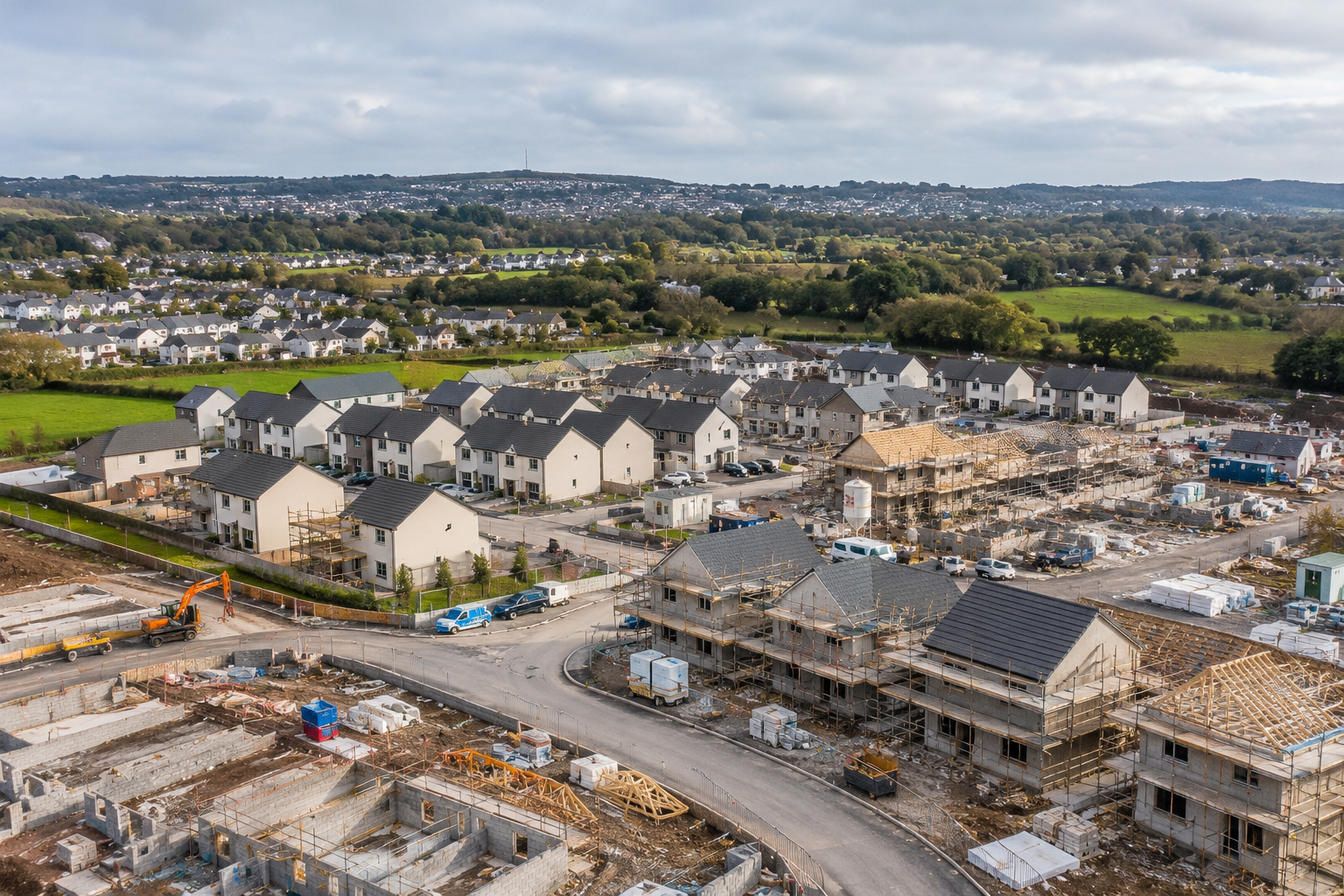
For years, Dublin has been the obvious answer when talking about Ireland's biggest residential developments. But the latest figures from Cork are beginning to challenge that assumption.
Seven homes.
That's all that separated Cork from Dublin in the number of homes granted planning permission during the second quarter of 2026. Dublin's four local authorities approved 3,241 homes. Cork City and County approved 3,234. For a county that rarely dominates the national conversation about housing delivery, that's a remarkable result.
But the real story isn't that Cork nearly matched Dublin in one quarter. It's what could happen next.
Because if even a substantial portion of those approved developments progresses to construction, Cork could be entering a very different period for its residential sector. And for the contractors, developers and construction professionals working across Munster, that's worth paying attention to.
Has Ireland Been Overlooking Cork's Residential Potential?
When we talk about housing shortages, major developments and construction activity in Ireland, Dublin tends to dominate the conversation.
Understandably so.
The capital has experienced enormous pressure to deliver new housing, with major residential schemes becoming a familiar feature od its construction landscape. But focusing so heavily on Dublin. can mean overlooking what's developing elsewhere. Cork isn't simply another regional housing market.
It's Ireland's second largest city, with a substantial surrounding county, established construction companies, growing employment centres and long term ambitions for urban expansion. And the latest planning figures suggest its residential pipeline could be gathering momentum.
During Q2 2026, Cork recorded 3,234 homes granted planning permission, including 1,775 apartments and 1,459 houses. Perhaps even more interesting is how those figures compare with the previous year. Apartment approvals increased by 302% while house approvals rose by 92.7%.
Those increases don't guarantee that every development will be built. Large planning decisions can also create considerable fluctuations between quarters. But they do raise an interesting question.
Are we beginning to see the foundations of a much larger residential construction market forming outside Dublin?
Cork's Next Chapter Might Look Very Different From Its Last
One of the most interesting aspects of Cork's potential growth is the type of residential development that could emerge. For many people, residential construction brings to mind housing estates expanding around towns and suburbs.
And those developments will continue to play an important role. But Cork's longer-term ambitions extend well beyond traditional housing schemes.
Take the docklands for example.
The redevelopment of Cork's Docklands has the potential to reshape a substantial part of the city, introducing new residential neighbourhoods into areas historically associated with port and industrial activity. Delivering housing in an urban environment like this is a very different proposition from building on a relatively straightforward suburban site. Land constraints, infrastructure requirements, access, logistics and the coordination of multiple disciplines can all add complexity.
Then there are areas such as Ballyvolane and Glanmire, where future residential growth could take a different form, involving new neighbourhoods, supporting infrastructure and phased housing developments.
What's interesting is that Cork's future residential market may not be defined by one type of construction. It could involve everything from complex city centre apartment schemes to large scale suburban developments. For the industry, that diversity matters. It creates different challenges, different delivery requirements and potentially a wider range of opportunities for construction companies with the experience to take them on.
Could Cork's Residential Growth Create a More Competitive Construction Market?
One of the more interesting questions surrounding Cork's residential pipeline is what happens if several major developments begin moving forward at the same time.
With thousands of homes receiving planning approval, the potential exists for a much busier residential market. But that could also change the competitive landscape for contractors working across Cork and the wider Munster region.
Companies that have traditionally operated on smaller residential schemes may find opportunities to tender for larger developments, while established contractors could look to strengthen their presence in the region. At the same time, an increase in active projects could create greater competition for experienced subcontractors, engineering teams and construction management professionals.
For those already working in Cork's construction sector, this could bring more than simply an increase in available projects. It could influence the types of developments contractors pursue, the responsibilities professionals take on and the opportunities available to progress without leaving the region.
The interesting part will be whether Cork's growing pipeline attracts new contractors into the market, encourages existing companies to expand or creates a combination of both. Either way, the impact of Cork's residential growth could be felt well beyond the number of homes eventually delivered.
Could Cork's Growth Change Where Construction Professionals Build Their Careers?
Greater competition between contractors could also have an interesting effect on the professionals working within the industry. For years Dublin has been a natural destination for construction professionals looking to gain experience on larger, more complex developments. But if Cork's residential pipeline continues to grow, could more of those opportunities begin emerging closer to home?
It's an interesting prospect, particularly for professionals who have spent years travelling for work or relocating to gain experience on major projects. For someone based in Cork, Kerry, Limerick or elsewhere in Munster, a stronger regional construction market could open up opportunities that previously meant travelling further afield. And it's not necessarily about securing a higher salary or a more senior job title.
The attraction could be gaining experience on a substantial development without relocating, taking on greater responsibility within a growing contractor or joining a company with a strong pipeline of projects in the region. There is also the potential for greater movement between employers. As contractors compete for experienced professionals, individuals may find themselves with more choice over the types of projects they work on and the direction they want their careers to take.
Of course, that depends on Cork's approved developments translating into sustained construction activity. But if the pipeline continues to progress, Cork could become an increasingly attractive option for professionals who want to advance their careers without having to look towards Dublin or further afield.
So, Is Cork Really Closing the Gap on Dublin?
In terms of residential planning approvals during Q2 2026, Cork came remarkably close. Just seven homes separated Cork City and County from Dublin's four local authorities. But the significance of those figures goes beyond a comparison between two regions. They point towards the possibility of a changing residential construction landscape in Ireland, where substantial development opportunities are not necessarily concentrated in the capital.
Cork already has ambitious plans for urban redevelopment, suburban expansion and housing growth across the wider county. If those plans continue to progress, the region could see a broader range of residential projects moving into construction over the coming years.
For contractors, that could mean new opportunities to secure work, expand their operations and compete for larger developments. For construction professionals, it could mean greater choice over where they work, the projects they become involved in and how they progress their careers.
Dublin will undoubtedly remain a major centre of residential construction, and one quarter of planning figures isn't enough to suggest that Cork is about to overtake it. But it does raise a question worth considering.
Could Ireland's next significant wave of residential construction activity emerge from a region that has spent years sitting outside the spotlight?
Cork's latest figures suggest it's a possibility. And for those working in Ireland's construction industry, it could be a market paying much closer attention to.
Get in Touch
Want to find out how we can help your business grow? Get in touch with us by sending a message through this form!Related Articles

119 Irish Regeneration Projects: Where Regional Construction Demand Could Grow Next
When people talk about the next wave of construction in Ireland, attention usually goes to the same places. Housing. Dublin. Data centres. Pharmaceutical projects. Major infrastructure. But one of the...
 Cathal McKeever

3 Must-Ask Questions to End Your Construction Interview
3 Must-Ask Questions to End Your Construction Interview When it comes to construction interviews, most candidates spend all their time preparing to answer tough questions. While that’s important...
Cathal McKeever
Are Construction Professionals Expected to Sacrifice Too Much?
Are Construction Professionals Expected to Sacrifice Too Much? Long hours. Long commutes. Constant pressure. Time away from family. ...
 Fionn Mac Néill

Are Data Centres the Golden Ticket? The Truth Behind Ireland's Most Talked-About Construction Sector
Are Data Centres the Golden Ticket? Walk into almost any construction site canteen, recruitment office, or industry event in Ireland today, and you'll hear the same conversation. ...
 Ryan Kieran

Are Your Construction Skills More Valuable Than You Think?
You'd Likely Be in Strong Demand Right Now When was the last time you stopped to think about your career? For most construction professionals, the answer is probably "not recently." Betwe...
 Stephen Nugent

Balancing Commute, Site Location & Career Growth in Ireland: Are You Optimising Your Construction Career?
The Decision That Can Shape Your Entire Construction Career It's Monday morning. Your alarm goes off at 5:15am. By 6am you're on the M50, heading towards a project that's over 90 minutes away. You tel...
Stephen Nugent
Breagh Recruitment: 10 Years in Construction Recruitment
Breagh Recruitment: 10 Years in ConstructionRecruitment – My Journey This October 2025, Breagh Recruitment turns ten and I couldn’t be prouder. But our story started long before the f...
Cathal McKeever
Breagh Recruitment 2025: A Year of Growth, Grit and Milestones
Breagh Recruitment 2025: A Year of Growth, Grit and Milestones As 2025 comes to a close, it’s a natural time to pause, reflect, and take stock of just how far Breagh Recruitment has come not jus...
Cathal McKeever
Breagh Recruitment Celebrates Excellence at the Irish Construction Industry Awards 2025
Breagh Recruitment had the privilege of attending the Irish Construction Industry Awards 2025 at the Convention Centre Dublin. It was a memorable even...
Cathal McKeever
Built by Humans, Run by Robots: The Engineering Wonder That Is Yangshan Port
Built by Humans, Run by Robots: The Engineering Wonder That Is Yangshan Port At Breagh, we live and breathe construction and engineering. But every now and then, we come across a project that makes ev...
Cathal McKeever
