


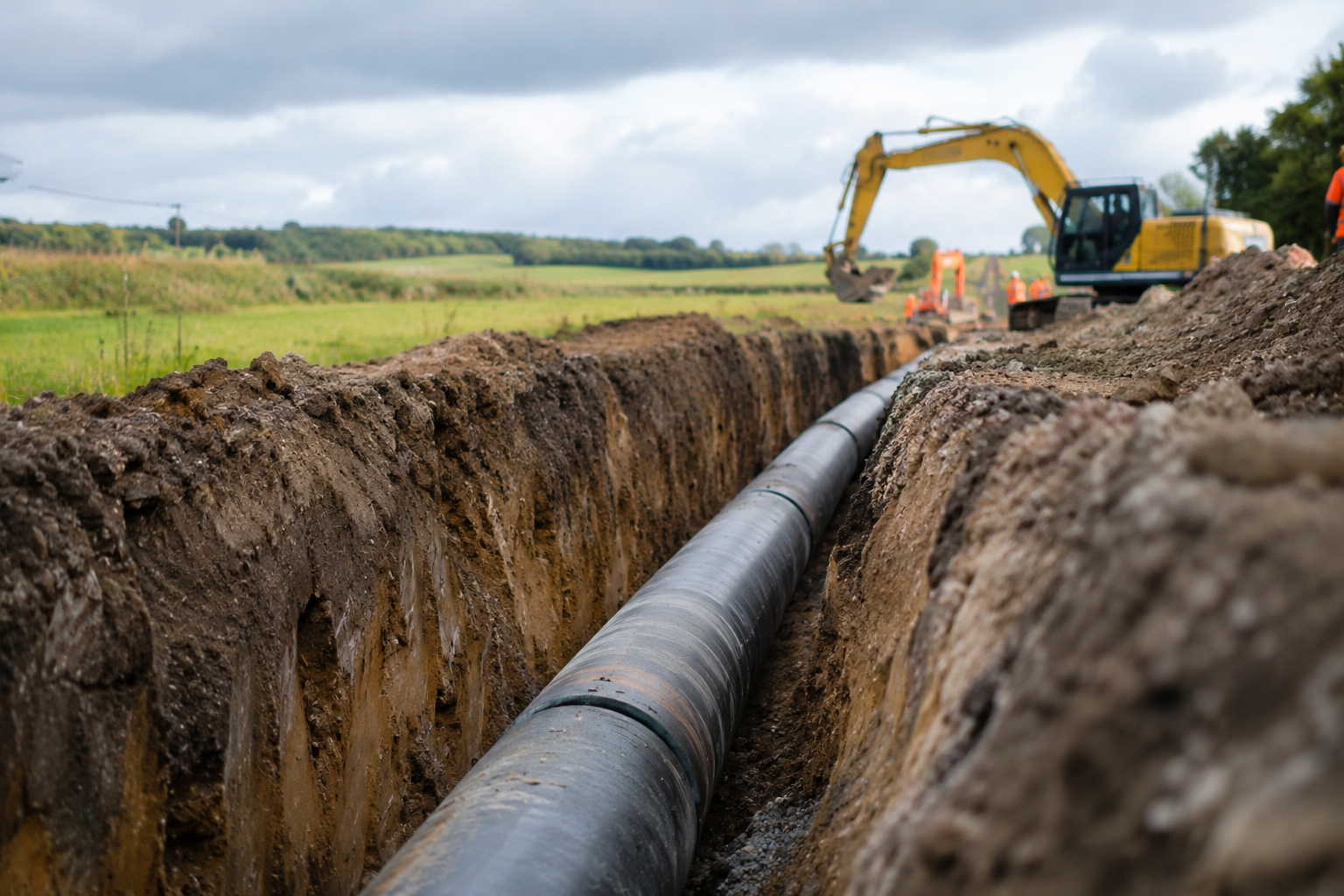
Ireland's biggest construction projects usually make headlines when something rises above ground. But could some of the country's most significant construction work over the coming years be happening beneath our feet?
When people talk about Ireland's next construction boom, the conversation usually turns to housing developments, data centres, commercial buildings and major industrial projects.
They're the projects we can see taking shape. Cranes appearing on skylines, steel structures rising and new developments transforming towns and cities.
But what about the construction work happening underneath them?
Across Ireland, billions of euro are being invested in electricity networks, water infrastructure, drainage systems and underground transport connections.
Much of this work won't result in a new building that people can point towards. Instead, it will involve kilometres of buried cables, pipelines, pumping stations, sewer networks and tunnels.
And when you look at the scale of what's being planned, it raises an interesting question.
Could Ireland's next major construction opportunity be happening beneath our feet?
Billions Are Being Invested in Infrastructure Most People Will Never See
Ireland has ambitious plans for housing, energy, transport and industrial development.
But delivering those plans requires more than constructing buildings.
New homes need water and wastewater connections. Data centres and industrial facilities need reliable electricity supplies. Growing cities need drainage networks capable of handling increased demand.
And much of that infrastructure needs to be installed or upgraded before the developments it supports can operate.
The investment figures give an indication of the scale involved.
Ireland's electricity networks have been approved for up to €18.9 billion in investment between 2026 and 2030, while Uisce Éireann's 2025–2029 funding plan includes approximately €10.3 billion for water infrastructure and assets.
Not all of this investment will be spent underground, but a significant amount of the work involves the networks that support Ireland's wider construction industry.
Several major projects are already demonstrating what that looks like in practice.
1. Dublin's Electricity Network Is Being Rebuilt Beneath the City
As Dublin continues to grow, its electricity network needs to support increasing demand from housing, businesses, transport and industry.
EirGrid's Powering Up Dublin programme involves installing more than 50 kilometres of high-voltage underground cables, replacing ageing infrastructure and upgrading substations across the capital.
Some sections involve complex engineering challenges, including working beneath existing roads and navigating underground services in heavily developed areas.
Think about what that involves from a construction perspective.
Excavations, traffic management, cable installation, temporary works and coordinating multiple contractors across busy urban environments.
And it's not just Dublin.
Ireland's wider electricity investment programme includes approximately 319 kilometres of new underground cables and 55 kilometres of replacement underground cables.
For civil engineering contractors, electrical specialists and infrastructure professionals, that represents a substantial pipeline of potential work.
2. Ireland's Water Infrastructure Could Be Just as Significant
Water and wastewater infrastructure rarely attracts the same attention as housing announcements.
Yet without sufficient capacity, new developments can face serious limitations.
One of the clearest examples is the Greater Dublin Drainage Project.
The project includes a new wastewater treatment facility at Clonshaugh, an underground orbital sewer, pumping infrastructure and a marine outfall to the Irish Sea.
It's designed to provide wastewater treatment capacity equivalent to approximately 500,000 people and support the delivery of up to 185,000 new homes across the wider Dublin region.
Preparatory works began in 2026, with main construction expected to begin in 2028 and completion targeted for 2031.
And this isn't an isolated investment.
In February 2026, Uisce Éireann launched procurement processes for Greater Dublin Drainage and the Water Supply Project for the Eastern and Midlands Region, representing a combined investment of more than €7 billion.
These programmes involve major civil engineering, pipeline, mechanical and electrical works.
But what makes them particularly interesting is their wider impact.
The infrastructure being built underground could help determine how much construction can happen above ground in the years ahead.
3. MetroLink Could Introduce Underground Construction on Another Scale
Dublin's MetroLink is another example of how significant underground construction could become.
In September 2026, the Government approved the project to proceed to the detailed tender stage, allowing bids to be sought for construction and operation.
Significant enabling works are expected to begin in 2027, followed by major tunnelling and station construction, subject to procurement and delivery progress.
Unlike conventional building projects, underground rail construction brings a different set of technical challenges.
Deep excavations, tunnel boring operations, ground movement monitoring, underground station structures and complex temporary works all become central to delivery.
For Irish construction professionals, MetroLink could create opportunities to gain experience on highly specialised engineering works that are less common in the domestic market.
The scale of those opportunities will depend on contract awards and construction timelines, but the project offers another indication of where future infrastructure demand could emerge.
4. The Celtic Interconnector Shows How Far Underground Infrastructure Can Extend
Another example can be found in Cork.
The Celtic Interconnector is being developed to connect Ireland's electricity network directly with France.
The project involves approximately 575 kilometres of cable, including around 500 kilometres beneath the sea.
On the Irish side, underground electricity connections link the coastal landing point in east Cork to the wider transmission network.
In May 2026, EirGrid confirmed that installation and testing of 44 kilometres of onshore high-voltage cable had been completed.
The overall project is targeting commissioning in the final quarter of 2028.
Although the Irish onshore cable installation has reached a major milestone, the project demonstrates the specialist construction involved in modern electricity infrastructure.
Trenching, ducting, cable jointing and working around existing services are all important parts of delivery.
As Ireland continues investing in electricity transmission and renewable energy connections, experience gained on projects like this could become increasingly relevant.
Why Underground Construction Could Become a Bigger Part of Ireland's Construction Industry
There's a common thread connecting these projects.
Ireland isn't simply trying to build more. It's trying to increase the capacity of the infrastructure that supports what already exists, while preparing for future demand.
Consider a major residential development.
The most visible stages might be the foundations, structural works and completion of the houses themselves.
But before residents can move in, the development needs electricity, water, drainage and wastewater connections.
The same applies to industrial facilities, commercial developments and transport infrastructure.
In some cases, existing networks need substantial reinforcement before further development can proceed.
Instead of infrastructure simply following development, infrastructure investment can become the factor that determines where and when development is possible.
And that's why the current pipeline of underground works deserves more attention.
What Could This Mean for Construction Professionals in Ireland?
For anyone working in civil engineering, utilities, mechanical and electrical construction or infrastructure delivery, the potential opportunities extend beyond the projects themselves.
Underground infrastructure requires a wide range of experience, including:
-
Civil and Site Engineers – excavations, underground services, setting out and drainage installations.
-
Project and Site Managers – coordinating contractors, programmes and complex infrastructure works.
-
Quantity Surveyors – managing costs, subcontractor packages and commercial risks.
-
Electrical Engineers – high-voltage cable installations, substations and grid connections.
-
Mechanical Engineers – pumping stations, water treatment systems and associated infrastructure.
-
Health and Safety Professionals – excavation safety, confined spaces and underground construction risks.
These aren't entirely new roles within Irish construction.
What's interesting is the possibility that experience in these areas could become increasingly valuable as more infrastructure programmes move into construction.
And opportunities may not be limited to Dublin.
Regional water upgrades, electricity network reinforcement and utility connections could create demand across multiple counties, particularly through civil engineering contractors and infrastructure frameworks.
For construction professionals considering their next move, it may be worth looking beyond traditional residential and commercial projects.
Some of the most interesting opportunities could emerge in the infrastructure that makes those developments possible.
So, Is Ireland Heading for an Underground Construction Boom?
There's a strong case that underground infrastructure will account for a significant part of Ireland's construction workload over the coming years.
The investment is substantial, the need for upgrades is clear, and several major projects are already progressing through construction, procurement or preparatory stages.
Of course, investment announcements don't automatically translate into immediate work on site. Planning, procurement, funding and specialist capacity will all influence how quickly projects progress.
But there's something interesting about where Ireland's construction industry could be heading.
For years, construction growth has largely been judged by what's visible: the number of cranes, the scale of developments and the buildings changing our skylines.
Yet over the next decade, some of Ireland's most important construction work might be the work we barely notice once it's finished.
Because before Ireland can build what's next, it may first need to build what's underneath.
At Breagh Recruitment, we work with construction and engineering professionals across Ireland, including those involved in civil engineering, utilities, infrastructure and M&E projects.
If you're interested in exploring where your experience could take you next, browse our latest construction and engineering opportunities or speak confidentially with our team.
Get in Touch
Want to find out how we can help your business grow? Get in touch with us by sending a message through this form!Related Articles

119 Irish Regeneration Projects: Where Regional Construction Demand Could Grow Next
When people talk about the next wave of construction in Ireland, attention usually goes to the same places. Housing. Dublin. Data centres. Pharmaceutical projects. Major infrastructure. But one of the...
 Cathal McKeever

3 Must-Ask Questions to End Your Construction Interview
3 Must-Ask Questions to End Your Construction Interview When it comes to construction interviews, most candidates spend all their time preparing to answer tough questions. While that’s important...
Cathal McKeever
Are Construction Professionals Expected to Sacrifice Too Much?
Are Construction Professionals Expected to Sacrifice Too Much? Long hours. Long commutes. Constant pressure. Time away from family. ...
 Fionn Mac Néill

Are Data Centres the Golden Ticket? The Truth Behind Ireland's Most Talked-About Construction Sector
Are Data Centres the Golden Ticket? Walk into almost any construction site canteen, recruitment office, or industry event in Ireland today, and you'll hear the same conversation. ...
 Ryan Kieran

Are Your Construction Skills More Valuable Than You Think?
You'd Likely Be in Strong Demand Right Now When was the last time you stopped to think about your career? For most construction professionals, the answer is probably "not recently." Betwe...
 Stephen Nugent

Balancing Commute, Site Location & Career Growth in Ireland: Are You Optimising Your Construction Career?
The Decision That Can Shape Your Entire Construction Career It's Monday morning. Your alarm goes off at 5:15am. By 6am you're on the M50, heading towards a project that's over 90 minutes away. You tel...
Stephen Nugent
Breagh Recruitment: 10 Years in Construction Recruitment
Breagh Recruitment: 10 Years in ConstructionRecruitment – My Journey This October 2025, Breagh Recruitment turns ten and I couldn’t be prouder. But our story started long before the f...
Cathal McKeever
Breagh Recruitment 2025: A Year of Growth, Grit and Milestones
Breagh Recruitment 2025: A Year of Growth, Grit and Milestones As 2025 comes to a close, it’s a natural time to pause, reflect, and take stock of just how far Breagh Recruitment has come not jus...
Cathal McKeever
Breagh Recruitment Celebrates Excellence at the Irish Construction Industry Awards 2025
Breagh Recruitment had the privilege of attending the Irish Construction Industry Awards 2025 at the Convention Centre Dublin. It was a memorable even...
Cathal McKeever
Built by Humans, Run by Robots: The Engineering Wonder That Is Yangshan Port
Built by Humans, Run by Robots: The Engineering Wonder That Is Yangshan Port At Breagh, we live and breathe construction and engineering. But every now and then, we come across a project that makes ev...
Cathal McKeever
