



When people talk about career progression in construction, there is an assumption that comes up again and again:
The bigger the company, the better the opportunity.
A bigger contractor can mean bigger projects, a more recognisable name on your CV, clearer structures and potentially stronger packages.
So, naturally, moving from a smaller contractor to a Tier 1 construction company can feel like an obvious step forward.
But is it?
Because when it comes to building a successful construction career in Ireland, the size of the company matters far less than something else:
What will you actually be doing when you get there?
Two construction professionals can spend three years with completely different companies and come out with very different levels of experience. And surprisingly, the person working for the bigger company isn't automatically the one who comes out ahead.
The Big Company Advantage Is Real
There are good reasons why major contractors attract ambitious construction professionals.
Imagine you're a Site Engineer who has spent the last few years working on €10m - €20m projects and you're offered the opportunity to join one of Ireland's largest contractors on a €200m development.
Immediately, there are things that become attractive.
The scale is different. The systems may be more sophisticated. You could be working alongside experienced Project Managers, Contracts Managers, Quantity Surveyors, Design Managers and specialist subcontractors.
You may gain exposure to BIM, complex programming, quality systems, commercial processes and reporting structures that simply aren't required on smaller projects.
And there is another advantage that shouldn't be ignored:
The name on your CV can carry weight.
If another employer knows the standards, systems and projects associated with a particular contractor, your experience becomes easier for them to understand.
But there is a catch.
A Bigger Project Doesn't Automatically Mean Bigger Experience
Imagine two Site Engineers start new jobs on the same Monday.
One joins a major contractor delivering a €250m project.
The other joins a smaller contractor delivering a €20m project.
Ask someone which Engineer will have the stronger CV two years later and most people would probably choose the €250m project.
But we are missing an important piece of information.
What were they actually responsible for?
The Engineer on the €250m project might spend those two years responsible for one particular section of the build. There could be several Engineers above and below them, dedicated teams for quality, design, planning, health and safety and commercial matters.
They become very good at their part of the project.
Meanwhile, the Engineer on the €20m project might be setting out, managing subcontractors, attending progress meetings, solving design issues, dealing directly with the Project Manager, coordinating works, completing QA documentation and gradually taking responsibility for large portions of the job.
Suddenly, the answer isn't quite as obvious.
This is where company size can become misleading.
Smaller Contractors Can Give You Something Bigger Companies Sometimes Can't
Proximity to responsibility.
In a smaller construction company, there are usually fewer layers between you and the people making decisions.
That can mean earlier exposure to responsibilities that might take considerably longer to reach within a larger organisation.
A Quantity Surveyor might have direct involvement with the Commercial Manager.
A Site Engineer might work closely with the Project Manager.
A Site Manager might have visibility across almost the entire project rather than one package.
You can sometimes see how the whole business operates rather than simply your individual part of it.
And that can accelerate development quickly.
There is a difference between having five years' experience and having one year of experience repeated five times.
The company that continuously expands your responsibility may ultimately do more for your career than the company with the biggest name.
But There Is a Flip Side
Smaller doesn't automatically mean better either.
A smaller contractor might offer greater responsibility because there simply aren't enough people.
And being given responsibility isn't the same as being developed.
If you're constantly figuring everything out yourself without strong senior support, proper systems or experienced people around you, you can develop gaps without even realising they are there.
That's where larger construction companies can have a major advantage.
The best ones don't simply give you impressive projects.
They give you structure.
Graduate programmes. Defined progression. Experienced management teams. Formal reviews. Established procedures. Specialist departments. Training.
For someone early in their construction career, that environment can be incredibly valuable.
So this isn't really an argument for big contractors or small contractors.
It's an argument for looking beyond the company logo.
The Question Most People Ask Is the Wrong One
When comparing two construction jobs, it is easy to ask:
Which company is better?
A much more useful question is:
Which company is better for what I need next?
That small difference completely changes how you evaluate an opportunity.
If you've spent four years with a smaller contractor and already have excellent hands-on experience, your next career move might benefit from exposure to larger, more complex projects and structured systems.
If you've spent four years with a major contractor but your responsibilities have remained relatively narrow, moving to a smaller or mid-sized contractor could give you the ownership you need to progress.
Your best move isn't necessarily up in company size.
Sometimes it is across into better experience.
Think About Your Career in Terms of Exposure
Before accepting your next construction job in Ireland, look beyond salary, company size and project value.
Ask what the role will expose you to.
Will you manage people?
Will you make decisions?
Will you attend client meetings?
Will you see a project through different stages?
Will you work alongside people you can genuinely learn from?
Will your responsibilities increase after 12 months?
Will you get experience you don't currently have?
And perhaps the most important question:
What will you be able to say you've done in two years that you can't say today?
That answer tells you far more about the value of an opportunity than the number of employees on the company's website.
Big Name or Big Responsibility?
There is no universal winner in the large contractor vs small contractor debate.
Ireland's major construction companies can offer exceptional careers, major projects, strong systems and exposure that is difficult to replicate elsewhere.
Smaller and mid-sized construction companies can offer equally valuable careers through greater responsibility, closer access to senior management and faster exposure to different areas of project delivery.
The mistake is assuming one automatically outranks the other.
Because ultimately, employers don't just hire the companies you've worked for.
They hire the experience you've gained while you were there.
So when your next opportunity comes along, don't only ask whether the company is bigger.
Ask whether the opportunity is.
Get in Touch
Want to find out how we can help your business grow? Get in touch with us by sending a message through this form!Related Articles

119 Irish Regeneration Projects: Where Regional Construction Demand Could Grow Next
When people talk about the next wave of construction in Ireland, attention usually goes to the same places. Housing. Dublin. Data centres. Pharmaceutical projects. Major infrastructure. But one of the...
 Cathal McKeever
3 Must-Ask Questions to End Your Construction Interview
3 Must-Ask Questions to End Your Construction Interview When it comes to construction interviews, most candidates spend all their time preparing to answer tough questions. While that’s important...
Cathal McKeever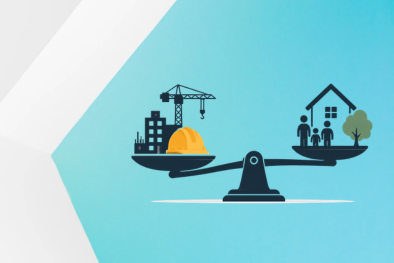
Are Construction Professionals Expected to Sacrifice Too Much?
Are Construction Professionals Expected to Sacrifice Too Much? Long hours. Long commutes. Constant pressure. Time away from family. ...
 Fionn Mac Néill
Are Data Centres the Golden Ticket? The Truth Behind Ireland's Most Talked-About Construction Sector
Are Data Centres the Golden Ticket? Walk into almost any construction site canteen, recruitment office, or industry event in Ireland today, and you'll hear the same conversation. ...
 Ryan Kieran
Are Your Construction Skills More Valuable Than You Think?
You'd Likely Be in Strong Demand Right Now When was the last time you stopped to think about your career? For most construction professionals, the answer is probably "not recently." Betwe...
 Stephen Nugent
Balancing Commute, Site Location & Career Growth in Ireland: Are You Optimising Your Construction Career?
The Decision That Can Shape Your Entire Construction Career It's Monday morning. Your alarm goes off at 5:15am. By 6am you're on the M50, heading towards a project that's over 90 minutes away. You tel...
Stephen Nugent
Breagh Recruitment: 10 Years in Construction Recruitment
Breagh Recruitment: 10 Years in ConstructionRecruitment – My Journey This October 2025, Breagh Recruitment turns ten and I couldn’t be prouder. But our story started long before the f...
Cathal McKeever
Breagh Recruitment 2025: A Year of Growth, Grit and Milestones
Breagh Recruitment 2025: A Year of Growth, Grit and Milestones As 2025 comes to a close, it’s a natural time to pause, reflect, and take stock of just how far Breagh Recruitment has come not jus...
Cathal McKeever
Breagh Recruitment Celebrates Excellence at the Irish Construction Industry Awards 2025
Breagh Recruitment had the privilege of attending the Irish Construction Industry Awards 2025 at the Convention Centre Dublin. It was a memorable even...
Cathal McKeever
Built by Humans, Run by Robots: The Engineering Wonder That Is Yangshan Port
Built by Humans, Run by Robots: The Engineering Wonder That Is Yangshan Port At Breagh, we live and breathe construction and engineering. But every now and then, we come across a project that makes ev...
Cathal McKeever
