


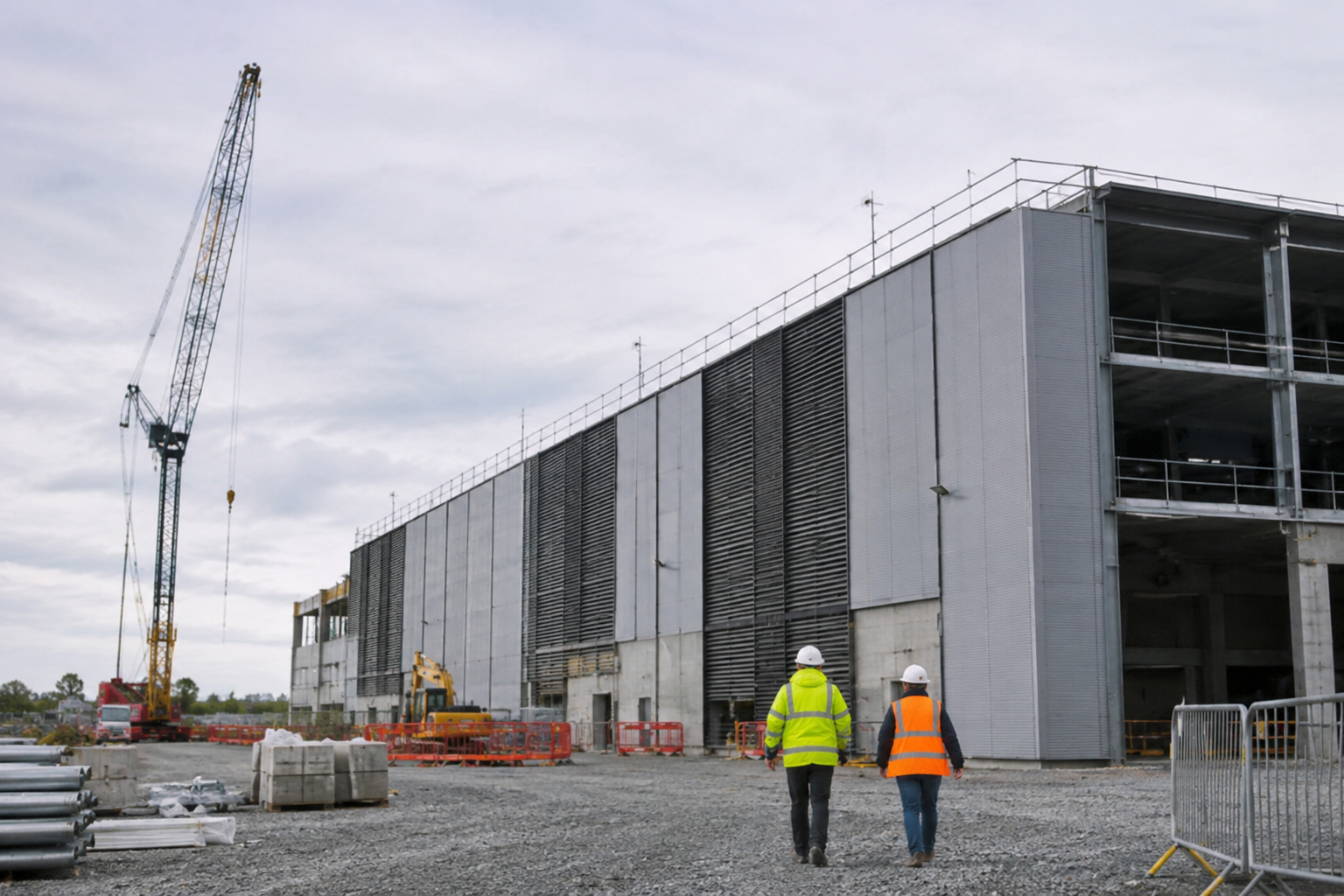
Artificial intelligence is often described as the next technological revolution. Billions are being invested in developing more powerful systems, businesses are changing how they operate, and technology companies are competing to build the next generation of AI tools.
But one of the biggest challenges facing the future of artificial intelligence has very little to do with software.
It has somewhere to put it, enough electricity to power it and the infrastructure to keep it running.
Before an AI system can answer a question, analyse information or automate a task, there is an entire network of physical infrastructure that needs to be designed, built, commissioned and maintained.
For Ireland's construction and engineering industry, this could present one of the most significant opportunities of the next decade.
AI Might Be Digital, but Its Infrastructure Isn't
When we talk about artificial intelligence, we tend to think about computers, algorithms and software. Rarely do we think about reinforced concrete, high-voltage substations, underground cabling or mechanical cooling systems.
Yet all of these are fundamental to its operation.
The growth of AI is increasing demand for:
-
Large-scale, high-density data centres
-
Electricity generation and transmission infrastructure
-
Specialist mechanical and electrical installations
-
Advanced cooling and water management systems
-
Fibre-optic networks and telecommunications infrastructure
-
Renewable energy developments and battery storage facilities
According to the
International Energy Agency's 2025 Energy and AI report global data centre electricity consumption is projected to more than double by 2030, reaching approximately 945 TWh. Artificial intelligence is expected to be the principal driver of that growth.
That is more electricity than Japan consumed annually at the time of the report.
The scale of the infrastructure required to accommodate that growth is enormous, and much of it falls within the remit of the construction and engineering industry.
Why AI Is Changing How Data Centres Are Built
Ireland is no stranger to data centre construction. However, the facilities required to support increasingly advanced AI systems are beginning to change the technical demands placed on contractors.
Traditional data centres were largely designed around cloud computing, data storage and conventional digital services. AI workloads can require considerably higher computing densities, increasing the amount of electricity and cooling required within the same physical space.
This creates a different set of engineering challenges.
Mechanical engineers must consider more advanced heat removal systems. Electrical engineers must accommodate greater power demands. Structural engineers may need to account for heavier equipment, while commissioning teams face increasingly complex systems that must operate reliably together.
Direct-to-chip liquid cooling, for example, is becoming more relevant as conventional air-cooling systems face limitations when dealing with high-density computing equipment.
For contractors, this means that the evolution of AI is not simply creating demand for more data centres. It is changing the specification, complexity and delivery of the buildings themselves.
Ireland's Electricity Network Could Be One of AI's Biggest Challenges
Building a data centre is one thing. Securing enough electricity to operate it is another.
In 2015, data centres accounted for just 5% of Ireland's metered electricity consumption. By 2020, that figure had risen to 11%, increasing to 18% in 2022 and 22% in 2024.
These figures from the Central Statistics Office demonstrate just how significantly Ireland's electricity landscape has changed in a relatively short period.
While not all data centre activity is related to artificial intelligence, the continued expansion of AI could place further pressure on an electricity network already facing growing demand from housing, transport and industrial development.
In December 2025, the Commission for Regulation of Utilities published a new electricity connection policy for data centres, placing greater emphasis on renewable electricity, generation or storage capacity and the availability of local grid infrastructure.
For Ireland's construction industry, this raises an interesting prospect.
Some of the most significant construction projects associated with artificial intelligence may not be data centres at all. Instead, they could be high-voltage substations, transmission networks, wind farms, battery energy storage facilities and underground electricity connections.
The availability of suitable development land alone may no longer be enough to attract major technology investment. Access to reliable electricity infrastructure could increasingly determine where future developments take place.
For civil engineering contractors, electrical specialists and professionals working within the energy sector, the growth of AI could therefore create opportunities far beyond the boundaries of a traditional data centre construction site.
The Growing Importance of Water and Cooling Infrastructure
Electricity receives much of the attention in discussions surrounding AI, but heat presents another significant engineering challenge.
The more densely computing equipment is installed, the more challenging it becomes to remove the heat it generates.
Cooling requirements are influencing mechanical design decisions, equipment selection, plant room layouts and the wider operational efficiency of data centre facilities.
Depending on the cooling technology used, developments may require additional water infrastructure, specialist pipework, heat exchangers, water treatment equipment and sophisticated monitoring systems.
There is also growing interest in finding productive uses for the heat generated by data centres.
Ireland already has an example of this through the Tallaght District Heating Scheme, which uses recovered heat from a local data centre to supply nearby buildings.
If similar systems become more commercially viable, data centre developments could increasingly intersect with district heating networks and wider urban infrastructure projects.
For mechanical contractors and building services engineers, the opportunity extends well beyond installing equipment inside a server hall.
Could Construction Become a Bottleneck for Artificial Intelligence?
Technology companies can develop software at remarkable speeds. Physical infrastructure cannot always move at the same pace.
Planning approvals, grid connections, long-lead electrical equipment, specialist labour availability and complex commissioning requirements can all affect when a facility becomes operational.
A technology company could have the funding, computing equipment and customers ready, yet still be waiting for the infrastructure needed to bring everything together.
This creates an interesting shift in the relationship between technology and construction.
The speed at which artificial intelligence can expand is becoming increasingly dependent on the ability of engineers, contractors and infrastructure providers to deliver technically demanding projects.
A delayed transformer delivery or an unavailable grid connection could have consequences far beyond the construction programme itself.
For an industry often perceived as slower to evolve than technology, construction could become one of the factors determining how quickly the technology sector progresses.
What Does AI Infrastructure Mean for Irish Construction Professionals?
Ireland's experience in delivering technically complex projects across data centres, pharmaceutical facilities, advanced manufacturing and energy infrastructure puts its construction workforce in an interesting position.
Many of the skills developed within these sectors are transferable to the infrastructure required to support AI.
Disciplines that could benefit from continued investment include:
-
Mechanical and Electrical Engineers
-
Civil and Structural Engineers
-
Mechanical and Electrical Project Managers
-
Commissioning Engineers and Managers
-
Construction Planners
-
Quantity Surveyors
-
BIM Coordinators and Managers
-
Health and Safety Professionals
-
High-Voltage and Power Systems Engineers
However, the opportunity is not necessarily limited to professionals who already have data centre experience.
Someone with a background in pharmaceutical construction may have valuable experience in complex mechanical installations, controlled environments and detailed commissioning processes.
A civil engineer working on utilities projects may be well positioned to move into the supporting infrastructure required by major technology developments.
Similarly, an electrical engineer with experience in substations or power distribution may find that their expertise becomes increasingly relevant to digital infrastructure projects.
Irish contractors delivering major developments across Europe also mean that these opportunities are not confined to Ireland's domestic construction market.
Could Existing Infrastructure Become Just as Valuable as New Construction?
Much of the discussion around AI infrastructure focuses on new developments. However, another area worth watching is the potential upgrading of existing facilities.
Not every data centre currently operating was designed to accommodate the power densities and cooling requirements associated with advanced AI workloads.
Where commercially and technically feasible, existing facilities may require significant modifications to support new equipment.
This could involve electrical capacity upgrades, replacement cooling systems, additional mechanical plant, structural modifications and changes to existing distribution networks.
Retrofitting a live, mission-critical facility presents its own challenges, particularly where existing operations must continue throughout construction.
For specialist contractors, this could create a valuable stream of work alongside new-build developments.
Will AI Create More Construction Jobs Than It Replaces?
There has been considerable discussion about the potential for artificial intelligence to automate tasks within the construction industry.
Estimating, scheduling, design coordination, documentation and project reporting are all areas where AI could influence how professionals work.
But there is another side to that conversation.
While AI may automate certain responsibilities, its expansion also requires people to construct the physical infrastructure that supports it.
Substations still need to be built. Mechanical systems still need to be installed. Electrical installations still need to be tested, and complex facilities still need experienced professionals to manage their delivery.
There is no guarantee that new infrastructure jobs will outweigh every role affected by automation. However, it highlights why the relationship between AI and construction is more complicated than simply asking which jobs technology might replace.
Some construction professionals may spend their careers using AI. Others may spend their careers building the infrastructure that allows everyone else to use it.
The Future of Technology Is Being Built on Construction Sites
The companies leading the artificial intelligence revolution may be best known for their software, but their ambitions are increasingly tied to physical assets.
Access to electricity, specialist engineering expertise, construction capacity and reliable infrastructure could become just as important to their expansion as their next technological breakthrough.
For Ireland, the challenge will be balancing digital investment with electricity availability, environmental commitments and the infrastructure needs of a growing population.
For construction professionals, however, it offers an interesting perspective on where future demand could emerge.
The next major opportunity created by artificial intelligence might not be found in a technology company.
It might be found on a construction site.
At Breagh Recruitment, we work with construction and engineering professionals across Ireland and Europe, connecting experienced individuals with opportunities in data centres, energy, infrastructure, mechanical and electrical engineering and specialist construction.
Get in Touch
Want to find out how we can help your business grow? Get in touch with us by sending a message through this form!Related Articles
119 Irish Regeneration Projects: Where Regional Construction Demand Could Grow Next
When people talk about the next wave of construction in Ireland, attention usually goes to the same places. Housing. Dublin. Data centres. Pharmaceutical projects. Major infrastructure. But one of the...
 Cathal McKeever

3 Must-Ask Questions to End Your Construction Interview
3 Must-Ask Questions to End Your Construction Interview When it comes to construction interviews, most candidates spend all their time preparing to answer tough questions. While that’s important...
Cathal McKeever
Are Construction Professionals Expected to Sacrifice Too Much?
Are Construction Professionals Expected to Sacrifice Too Much? Long hours. Long commutes. Constant pressure. Time away from family. ...
 Fionn Mac Néill

Are Data Centres the Golden Ticket? The Truth Behind Ireland's Most Talked-About Construction Sector
Are Data Centres the Golden Ticket? Walk into almost any construction site canteen, recruitment office, or industry event in Ireland today, and you'll hear the same conversation. ...
 Ryan Kieran

Are Your Construction Skills More Valuable Than You Think?
You'd Likely Be in Strong Demand Right Now When was the last time you stopped to think about your career? For most construction professionals, the answer is probably "not recently." Betwe...
 Stephen Nugent

Balancing Commute, Site Location & Career Growth in Ireland: Are You Optimising Your Construction Career?
The Decision That Can Shape Your Entire Construction Career It's Monday morning. Your alarm goes off at 5:15am. By 6am you're on the M50, heading towards a project that's over 90 minutes away. You tel...
Stephen Nugent
Breagh Recruitment: 10 Years in Construction Recruitment
Breagh Recruitment: 10 Years in ConstructionRecruitment – My Journey This October 2025, Breagh Recruitment turns ten and I couldn’t be prouder. But our story started long before the f...
Cathal McKeever
Breagh Recruitment 2025: A Year of Growth, Grit and Milestones
Breagh Recruitment 2025: A Year of Growth, Grit and Milestones As 2025 comes to a close, it’s a natural time to pause, reflect, and take stock of just how far Breagh Recruitment has come not jus...
Cathal McKeever
Breagh Recruitment Celebrates Excellence at the Irish Construction Industry Awards 2025
Breagh Recruitment had the privilege of attending the Irish Construction Industry Awards 2025 at the Convention Centre Dublin. It was a memorable even...
Cathal McKeever
Built by Humans, Run by Robots: The Engineering Wonder That Is Yangshan Port
Built by Humans, Run by Robots: The Engineering Wonder That Is Yangshan Port At Breagh, we live and breathe construction and engineering. But every now and then, we come across a project that makes ev...
Cathal McKeever
