


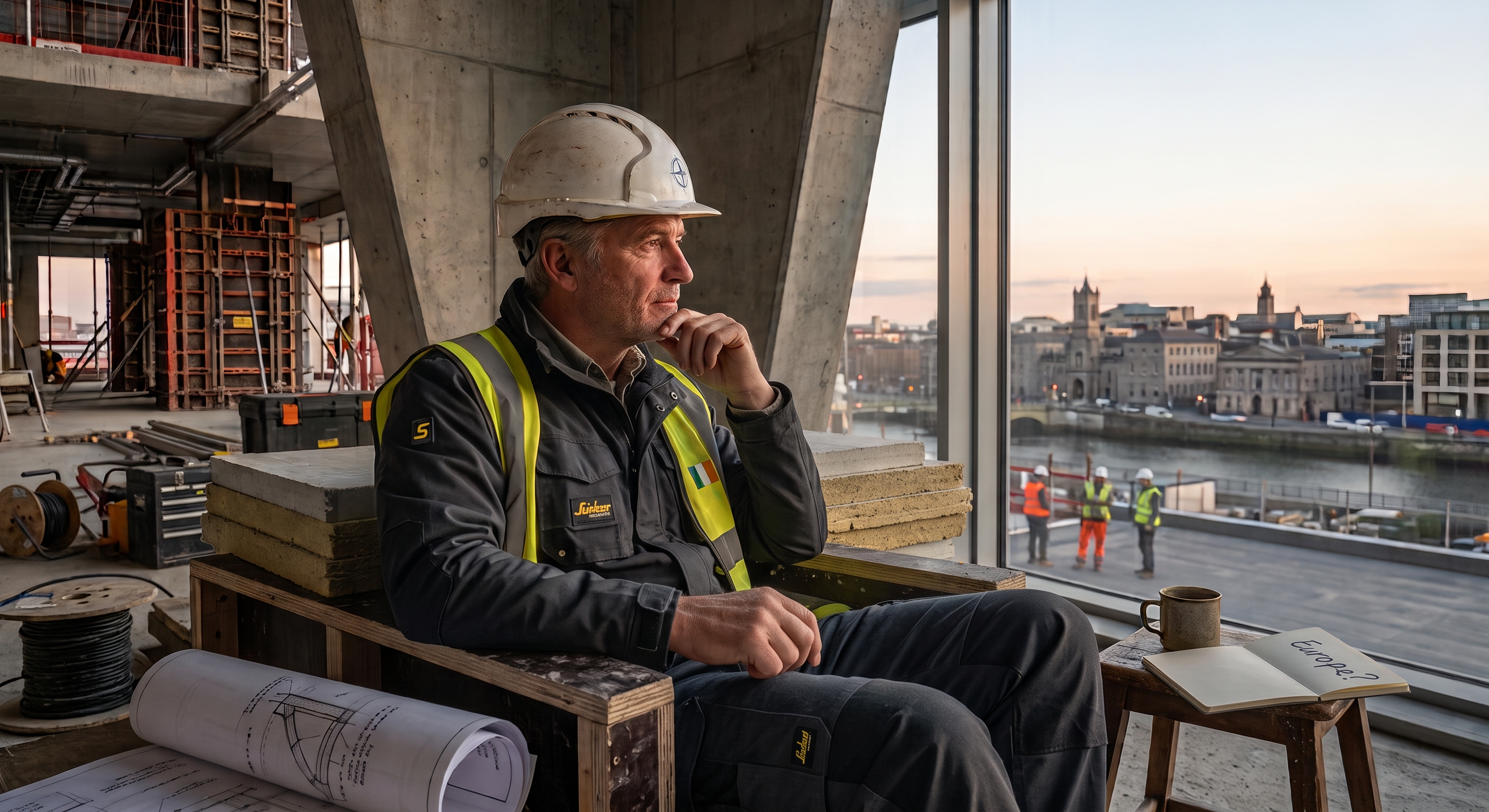
A €100,000 salary.
Accommodation included.
Flights home.
A major project in Germany, the Netherlands or the Nordics.
On paper, it can look like an obvious move.
But a European construction opportunity isn't automatically a good opportunity just because the salary is higher or the project is bigger.
For Irish construction professionals considering working in Europe, the better question isn't:
"Is Europe worth it?"
It's:
"Is this particular opportunity worth it for me?"
Because two jobs with similar salaries can offer completely different experiences once you look at the project, rotation, accommodation, tax, travel, responsibilities and what the role will actually add to your career.
And those details matter.
Why are more Irish construction professionals looking at Europe?
Working in Europe isn't particularly new for Irish construction professionals, but the scale and type of opportunities available has changed.
Irish contractors have built significant expertise in areas such as data centres and high-tech construction, and that expertise is increasingly being exported internationally.
The Irish Government reported that approximately €2.1 billion of Ireland's high-tech construction exports in 2024 were linked to data-centre activity alone. Irish contractors are now delivering major projects across markets including Germany, the UK and Northern Europe.
For Site Managers, Project Managers, Quantity Surveyors, Mechanical and Electrical professionals, Commissioning Managers, BIM specialists, Health & Safety professionals and engineers, that is creating a growing range of European construction opportunities across major projects.
But more opportunities also mean more decisions.
And comparing them purely by salary can be a mistake.
1. Start with the project, not the country
It's easy to get caught up in the location.
Germany.
Netherlands.
Sweden.
Denmark.
Finland.
But the country itself tells you surprisingly little about whether the opportunity is right for your career.
Look at the project first.
What are you actually going to build?
A €100m project where you're given significant responsibility could potentially do more for your career than a €500m project where your role is extremely narrow.
Likewise, moving abroad simply to perform almost exactly the same responsibilities you're already carrying out in Ireland may not give you the career return you expected.
Find out:
What stage is the project currently at?
How large and technically complex is it?
How long is left on the programme?
What responsibilities will you personally have?
What team will you be working with?
What happens when this project finishes?
The best European opportunity isn't necessarily attached to the biggest project.
It's the one that gives you experience you can use again.
2. Look beyond the headline salary
This is probably one of the biggest mistakes people make when comparing European construction jobs.
Imagine you're earning €70,000 in Ireland and you're offered €95,000 abroad.
The immediate reaction is understandable.
That's €25,000 more.
But that's not really the comparison.
You need to understand what the entire move looks like financially.
Is accommodation paid for?
Are flights home included?
How frequently are those flights provided?
Are local transport costs covered?
Is there a living-away allowance?
Are meals or subsistence included?
Is overtime available?
How will you be taxed?
Who pays for travel days?
Are bonuses guaranteed or discretionary?
A higher salary can quickly become less impressive if you're paying for accommodation abroad while continuing to cover a mortgage or rent at home.
The opposite can also be true.
An opportunity with a slightly lower basic salary but accommodation, flights, transport and other costs covered could leave you considerably better off.
Compare what you keep and what you receive, not just the number at the top of the job description.
Tax also deserves proper attention. There isn't one universal tax rule covering every person working temporarily in another EU country. The position can depend on the length of the assignment, employment arrangement, national legislation and the relevant double-taxation agreement.
If the numbers are a major reason you're considering the move, understand them properly before accepting.
3. Rotation can matter as much as money
A European role can look fantastic until you realise what the working pattern actually means.
There is a considerable difference between coming home regularly and spending long uninterrupted periods abroad.
That's why "flights included" isn't enough information.
You want to know what life will actually look like.
How many weeks are you working before returning home?
How long are you home for?
Are travel days included in the rotation?
Who books the flights?
Can you choose the airport?
What happens if the project programme changes?
Are weekends normally worked?
For someone without major commitments at home, a longer rotation might be completely manageable.
For someone with a partner, children, sport, family responsibilities or other commitments in Ireland, the exact same rotation could make the opportunity unsustainable.
Neither person is making the wrong decision.
They're simply judging the opportunity against different lives.
A good rotation is one you can realistically maintain, not just tolerate for the first few months.
4. Ask exactly what "accommodation provided" means
This is one of those details that can completely change an opportunity.
"Accommodation provided" sounds straightforward.
It isn't always.
It could mean your own apartment.
It could mean sharing a house.
It could mean an apartment shared with several colleagues.
It could be beside the project.
Or it could involve a significant commute every morning.
Before moving country, you should know what you're agreeing to.
Ask whether you'll have your own room, how many people share the property, how far it is from site, whether utilities are included and whether transport between the accommodation and project is provided.
These might seem like small questions while you're sitting in Ireland considering the offer.
After six months abroad, they won't feel small.
5. Who are you actually going to work for?
The project gets attention.
The employer determines much of the experience.
Before accepting a European construction role, understand the contractor you're joining and their position in that market.
Do they already have an established European operation?
Are they entering the market for the first time?
Do they have several projects underway?
Are they following a major client across Europe?
What does their future pipeline look like?
Most importantly:
What happens to you when this particular project finishes?
A 12-month project can be a very different proposition if the contractor already has three more projects planned in the region.
That's when you're no longer evaluating one job.
You're evaluating a potential career path.
6. Think about what the job adds to your CV
Money matters.
But your next move should ideally increase your future options as well as your current salary.
Ask yourself what you'll be able to say after two years that you can't say today.
Maybe you've delivered a major data centre.
Maybe you've worked on a technically complex pharmaceutical facility.
Maybe you've managed larger teams.
Maybe you've progressed from Engineer to Senior Engineer.
Maybe you've gained experience managing subcontractors across several nationalities.
Maybe you've taken ownership of a project package worth significantly more than anything you've previously managed.
That is where European experience can become particularly valuable.
You're not simply adding another employer to your CV.
You're potentially adding scale, complexity, international experience and greater responsibility.
7. Bigger projects aren't automatically better projects for your career
A €500m project sounds impressive.
And it can be.
But project value shouldn't be confused with personal responsibility.
On an enormous project, you could spend two years responsible for one relatively narrow area.
On a smaller project, you might have visibility across procurement, programme, subcontractors, commercial decisions, client meetings and delivery.
Neither is automatically better.
It depends on what experience you're missing.
If your CV already contains major projects but you're lacking leadership responsibility, another enormous project in a narrow role might not change much.
If you've spent your career on smaller projects and want exposure to highly structured, complex international delivery, the large project might be exactly what you need.
Look at the size of your role, not only the size of the project.
8. Consider what happens when you eventually come home
This is the part people sometimes forget.
You don't have to stay in Europe forever for the move to be worthwhile.
For some construction professionals, Europe becomes a long-term career.
For others, it's two, three or five years before returning to Ireland.
So consider the return journey before you've even left.
If you came back to Ireland after three years, what would the European experience make you qualified for?
Would you return as essentially the same candidate with three additional years' experience?
Or would you return having managed bigger projects, larger teams, greater budgets and more technically complex work?
That distinction matters.
A European opportunity can be valuable not only because of what it pays you today, but because of what it could make you worth in five years.
9. Understand the practical side before saying yes
There are also practical considerations that shouldn't be left until after you've accepted.
For Irish and other EU professionals working temporarily in another EU country, the exact arrangements can depend on whether you're employed locally or being posted abroad by an existing employer.
EU rules provide protections around areas including remuneration, working hours, rest periods, annual leave, health and safety and, where relevant, accommodation.
For posted workers, social security arrangements can also differ from normal local employment. In qualifying circumstances, someone temporarily posted abroad can remain within their home country's social security system for up to 24 months using an A1 document.
These aren't details you need to become an expert in yourself.
But you should know which arrangement applies to you.
Before accepting, make sure there is clarity around:
-
Employment contract
-
Country of employment
-
Tax arrangements
-
Social insurance
-
Pension
-
Health insurance
-
Accommodation
-
Flights
-
Local transport
-
Rotation
-
Annual leave
-
Overtime
-
Expenses
-
Project duration
-
What happens after project completion
If someone can't clearly explain the terms of the opportunity before you relocate, that's information in itself.
10. The right European opportunity should solve more than one problem
This is probably the simplest way to judge the move.
Suppose your only reason for going to Europe is:
"They're paying me more."
That might still be enough.
But the strongest moves usually solve several things at once.
You're earning more.
You're getting a better project.
You're gaining experience you couldn't easily get at home.
You're taking on greater responsibility.
You're working with a contractor that has future projects.
And the rotation works with your life.
That's a very different proposition from accepting a job solely because the salary looks attractive.
So, is working in Europe the right move?
There isn't one answer.
For the right person, on the right project, with the right contractor and working arrangement, Europe can be an excellent career move.
For someone else, staying in Ireland could offer better progression, stability and quality of life.
And that's the point.
Europe itself isn't the opportunity. The individual job is.
Before deciding, strip away the headline salary and location and look at what you're actually being offered.
Look at the project.
Look at your responsibilities.
Look at the contractor's pipeline.
Look at the rotation.
Look at the accommodation.
Look at the real financial difference.
And finally, look at the person you could be professionally when the project is finished.
If those pieces make sense together, you've probably found an opportunity worth seriously considering.
If you're considering a move to Europe and want an honest conversation about the projects, salaries, rotations and opportunities currently available, speak with the Breagh Recruitment team. Even if you aren't ready to move immediately, understanding what's available can help you work out what the right next step looks like.
Get in Touch
Want to find out how we can help your business grow? Get in touch with us by sending a message through this form!Related Articles

119 Irish Regeneration Projects: Where Regional Construction Demand Could Grow Next
When people talk about the next wave of construction in Ireland, attention usually goes to the same places. Housing. Dublin. Data centres. Pharmaceutical projects. Major infrastructure. But one of the...
 Cathal McKeever
3 Must-Ask Questions to End Your Construction Interview
3 Must-Ask Questions to End Your Construction Interview When it comes to construction interviews, most candidates spend all their time preparing to answer tough questions. While that’s important...
Cathal McKeever
Are Construction Professionals Expected to Sacrifice Too Much?
Are Construction Professionals Expected to Sacrifice Too Much? Long hours. Long commutes. Constant pressure. Time away from family. ...
 Fionn Mac Néill
Are Data Centres the Golden Ticket? The Truth Behind Ireland's Most Talked-About Construction Sector
Are Data Centres the Golden Ticket? Walk into almost any construction site canteen, recruitment office, or industry event in Ireland today, and you'll hear the same conversation. ...
 Ryan Kieran
Are Your Construction Skills More Valuable Than You Think?
You'd Likely Be in Strong Demand Right Now When was the last time you stopped to think about your career? For most construction professionals, the answer is probably "not recently." Betwe...
 Stephen Nugent
Balancing Commute, Site Location & Career Growth in Ireland: Are You Optimising Your Construction Career?
The Decision That Can Shape Your Entire Construction Career It's Monday morning. Your alarm goes off at 5:15am. By 6am you're on the M50, heading towards a project that's over 90 minutes away. You tel...
Stephen Nugent
Breagh Recruitment: 10 Years in Construction Recruitment
Breagh Recruitment: 10 Years in ConstructionRecruitment – My Journey This October 2025, Breagh Recruitment turns ten and I couldn’t be prouder. But our story started long before the f...
Cathal McKeever
Breagh Recruitment 2025: A Year of Growth, Grit and Milestones
Breagh Recruitment 2025: A Year of Growth, Grit and Milestones As 2025 comes to a close, it’s a natural time to pause, reflect, and take stock of just how far Breagh Recruitment has come not jus...
Cathal McKeever
Breagh Recruitment Celebrates Excellence at the Irish Construction Industry Awards 2025
Breagh Recruitment had the privilege of attending the Irish Construction Industry Awards 2025 at the Convention Centre Dublin. It was a memorable even...
Cathal McKeever
Built by Humans, Run by Robots: The Engineering Wonder That Is Yangshan Port
Built by Humans, Run by Robots: The Engineering Wonder That Is Yangshan Port At Breagh, we live and breathe construction and engineering. But every now and then, we come across a project that makes ev...
Cathal McKeever
