


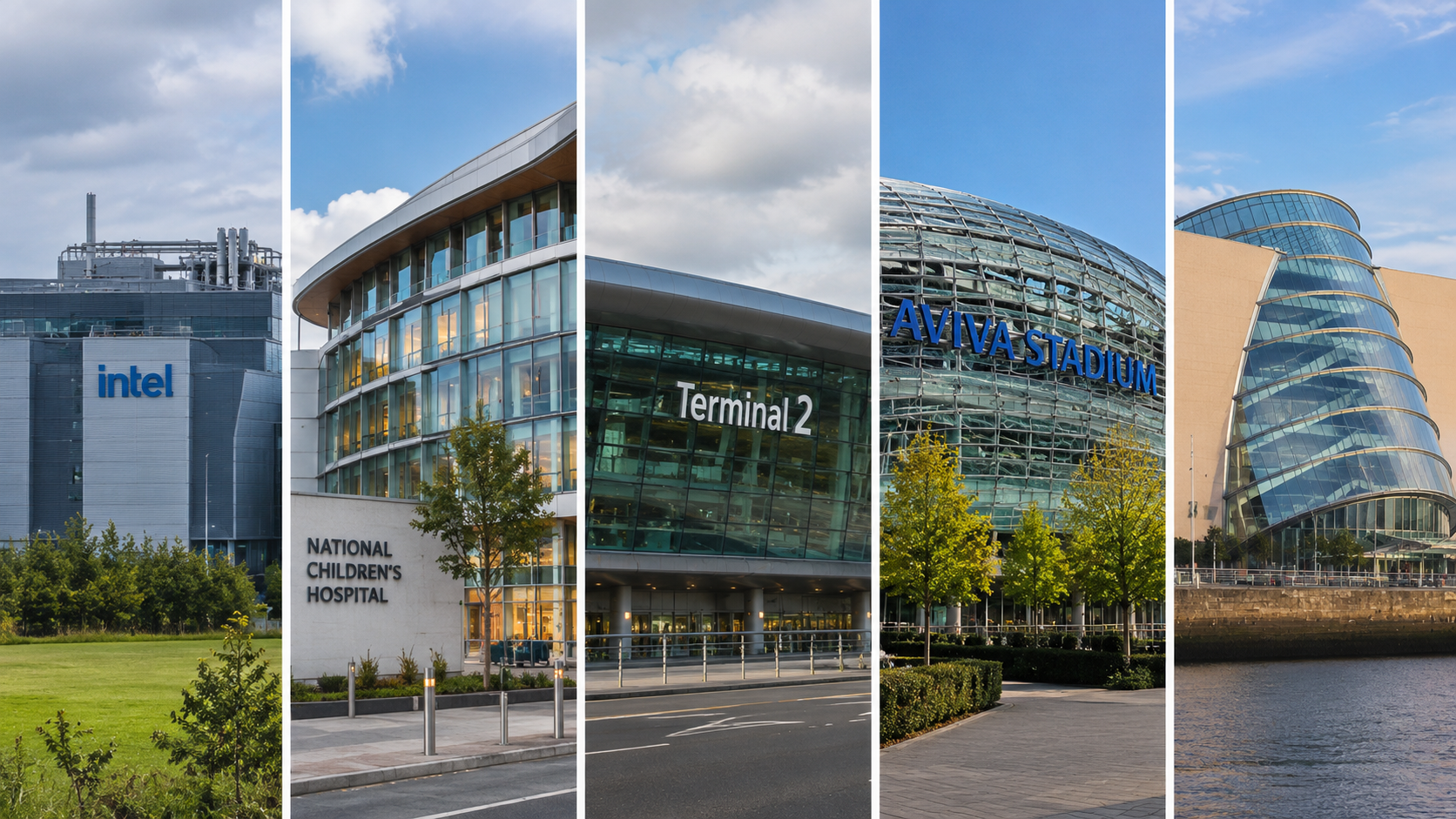
When you think of Ireland's most expensive buildings, what comes to mind?
The Aviva Stadium? The National Children's Hospital? Perhaps one of the enormous pharmaceutical or technology facilities that have appeared across the country over the past two decades?
Some of Ireland's most recognisable buildings have cost hundreds of millions of euro to construct. Others, which most people will never set foot inside, represent investments running into the billions.
But identifying the most expensive isn't quite as simple as comparing price tags.
From a €17 billion semiconductor development in Kildare to a hospital costing more than €2 billion in Dublin, Ireland has delivered projects that show just how expensive modern construction can become.
So which building takes the top spot, and what exactly makes these developments cost so much?
1. Intel Fab 34, Kildare – €17 Billion
If we're looking at the largest investment associated with an individual building development in Ireland, Intel's Fab 34 is difficult to overlook.
Located at the company's Leixlip campus in County Kildare, Fab 34 represents an investment of approximately €17 billion.
Construction began in 2019, with the first manufacturing module officially opening in September 2023 and the second coming online in early 2025.
According to Intel, it was the largest construction project ever undertaken in Ireland.
But why would a semiconductor manufacturing facility cost so much?
Unlike a conventional commercial building, a semiconductor fabrication plant requires an extraordinary level of precision.
Manufacturing advanced computer chips involves controlling airborne particles, temperature, vibration and other environmental conditions to exceptionally tight tolerances.
The building needs specialist cleanrooms, sophisticated mechanical and electrical systems, extensive utilities infrastructure and highly advanced production equipment.
In other words, the cost isn't simply in the structure itself. It's in everything required to make that structure capable of manufacturing some of the world's most advanced technology.
And that's an important distinction.
Intel's €17 billion figure represents investment in the fab development, not a separately published construction-only cost for the building.
Nevertheless, it demonstrates the scale of industrial construction taking place in Ireland, particularly in sectors where engineering systems and specialist equipment can account for an enormous share of overall expenditure.
2. National Children's Hospital, Dublin – €2.24 Billion
Few construction projects in Ireland have attracted as much attention as the new National Children's Hospital.
With an approved budget of €2.24 billion, it has become one of the country's most closely scrutinised public building developments.
However, that figure includes more than the physical hospital.
The Government's approved budget comprises approximately €1.88 billion for design, construction and equipping, including satellite centres, and a further €360 million for integration, commissioning, ICT and the transition of services.
The hospital itself is an exceptionally complex building.
Operating theatres, laboratories, critical care facilities, specialist medical equipment and extensive mechanical and electrical installations all need to work together.
Healthcare buildings also face demanding requirements around ventilation, infection control, safety and system reliability.
But technical complexity is only part of the story.
The project has experienced repeated delays, design disputes and substantial cost increases. By September 2026, the contractor had submitted approximately €983 million in disputed claims, although these claims do not automatically increase the approved project budget.
It illustrates something construction professionals know well: the original contract value doesn't always tell you what a project will ultimately cost.
The longer a major development takes to deliver, the greater the potential exposure to programme disruption, extended preliminaries, contractual disputes and additional expenditure.
And when a project involves thousands of interdependent systems, resolving problems late in construction can be particularly challenging.
3. Dublin Airport Terminal 2 – €600 Million
Dublin Airport's Terminal 2 might not immediately come to mind when discussing Ireland's most expensive buildings, but its construction represented a significant investment.
Opened in 2010, the terminal and its associated infrastructure formed part of a development costing approximately €600 million.
The project included a new passenger terminal, connecting pier, aircraft stands, utilities and associated airport infrastructure.
What makes an airport terminal particularly expensive is the amount of infrastructure needed beyond the passenger areas.
Baggage handling systems, security facilities, passenger processing technology, mechanical and electrical services and connections to the wider airport all contribute to the overall cost.
Unlike a conventional office development, an airport terminal also has to integrate with a complex, operational transport network.
Interestingly, the original €600 million programme figure was considerably higher than the estimated cost of the terminal building alone.
It's another example of why comparing major construction projects purely by their headline values can be misleading.
4. Aviva Stadium, Dublin – €410 Million
The Aviva Stadium is one of Ireland's most recognisable buildings, but its construction was far from straightforward.
Completed in 2010 at a reported cost of €410 million, the stadium replaced the original Lansdowne Road venue.
Its distinctive curved design was developed partly in response to the surrounding residential neighbourhood.
The project involved approximately 72,000 tonnes of in-situ concrete alongside 8,000 precast concrete units.
For construction professionals, the interesting part is how much the building's location and design influenced the project.
Delivering a large stadium within an established urban area presents challenges that wouldn't necessarily exist on an unrestricted greenfield site.
Site access, neighbouring properties, structural requirements and the construction sequence all become important considerations.
And unlike a standard commercial building, a stadium needs to accommodate tens of thousands of people while meeting demanding safety, circulation and operational requirements.
The result is a building where the complexity goes well beyond what can be seen from the outside.
5. Convention Centre Dublin – €226 Million Construction Contract
Another familiar Dublin landmark, the Convention Centre opened in 2010.
Its construction contract was valued at approximately €226 million, according to main contractor Sisk, while the wider public-private partnership agreement was reported at €380 million.
The building includes a 2,000-seat auditorium, exhibition areas, meeting facilities and a distinctive glazed frontage overlooking the River Liffey.
The Convention Centre highlights the difference between a construction contract and the broader financial arrangements behind a development.
Its design required specialist glazing, large internal spaces and extensive building services, all within a prominent city-centre location.
But its total procurement arrangement also involved financing and operational responsibilities.
That makes it difficult to compare directly with a privately funded industrial facility or a publicly funded hospital.
How Do Ireland's Most Expensive Buildings Compare?
Looking at the reported figures, the difference between these developments is substantial.
-
Intel Fab 34, Kildare: €17 billion in development investment.
-
National Children's Hospital, Dublin: €2.24 billion approved project and programme budget.
-
Dublin Airport Terminal 2: €600 million wider development programme.
-
Aviva Stadium, Dublin: €410 million reported completion cost.
-
Convention Centre Dublin: €226 million construction contract.
These figures cover different scopes and are not a like-for-like ranking of construction costs.
Intel's Fab 34 represents a level of investment far beyond Ireland's best-known public and commercial buildings.
However, its figure includes the wider development and advanced manufacturing investment, meaning it cannot be treated as a direct equivalent to a stadium's construction cost.
There's also an important point about age. A building completed in 2010 was delivered under very different market conditions from one constructed in the 2020s.
Labour rates, materials, regulation, technology and inflation all affect what the same type of project might cost today.
Why Are Some Buildings So Much More Expensive Than Others?
The biggest factor isn't always the size of the building.
A large warehouse can be relatively straightforward to construct compared with a smaller pharmaceutical facility, hospital or data centre.
What matters is what the building needs to do.
For example, specialist manufacturing facilities can require enormous investment in mechanical and electrical systems, cleanrooms, process equipment and utility connections.
Hospitals need highly controlled environments, resilient power supplies, specialist medical installations and strict compliance with healthcare standards.
Even location makes a substantial difference.
Constructing a building on an unrestricted site is very different from delivering the same development in a congested city centre or alongside facilities that must remain operational.
Then there's the programme itself.
Complex designs, long procurement periods, specialist materials, late changes and delays can all influence the final cost.
The most expensive part of a building isn't necessarily the part you can see.
For many of Ireland's major industrial and healthcare developments, a significant amount of the investment sits behind walls, above ceilings and within the systems that allow the building to function.
Could Ireland's Next Record-Breaking Building Already Be in Development?
Ireland continues to attract investment in sectors where construction costs can be exceptionally high.
Semiconductor manufacturing, pharmaceuticals, biotechnology, data centres and advanced industrial facilities all depend on increasingly sophisticated buildings.
And as these sectors develop, the demand for specialist construction expertise becomes more important.
Mechanical and electrical engineers, project managers, quantity surveyors, commissioning specialists and construction managers all have roles to play in delivering facilities of this complexity.
For construction professionals, that's perhaps the most interesting part of the story.
Ireland's largest projects aren't necessarily the tallest buildings or the most recognisable landmarks.
Some of the most significant developments are industrial facilities that the public rarely gets to see.
And as the technology inside those buildings becomes more advanced, the cost of constructing and equipping them could continue to grow.
So, What Is the Most Expensive Building Ever Constructed in Ireland?
Based on the publicly reported figures examined here, Intel's Fab 34 in Leixlip is the standout contender when total development investment is considered, at approximately €17 billion.
However, that figure includes more than the construction of the building itself.
The National Children's Hospital is another major contender among publicly funded building projects, with an approved project and programme budget of €2.24 billion, although its final cost remains subject to unresolved matters.
There isn't a definitive, independently verified ranking of Irish buildings based solely on comparable construction costs.
What is clear is that the price of a building tells us far more than how much concrete, steel or glass went into constructing it.
It reflects the engineering, technology, infrastructure and expertise required to bring it into operation.
And with Ireland continuing to develop increasingly complex industrial and healthcare facilities, the next major construction investment might be somewhere most people would never think to look.
Get in Touch
Want to find out how we can help your business grow? Get in touch with us by sending a message through this form!Related Articles
119 Irish Regeneration Projects: Where Regional Construction Demand Could Grow Next
When people talk about the next wave of construction in Ireland, attention usually goes to the same places. Housing. Dublin. Data centres. Pharmaceutical projects. Major infrastructure. But one of the...
 Cathal McKeever

3 Must-Ask Questions to End Your Construction Interview
3 Must-Ask Questions to End Your Construction Interview When it comes to construction interviews, most candidates spend all their time preparing to answer tough questions. While that’s important...
Cathal McKeever
Are Construction Professionals Expected to Sacrifice Too Much?
Are Construction Professionals Expected to Sacrifice Too Much? Long hours. Long commutes. Constant pressure. Time away from family. ...
 Fionn Mac Néill

Are Data Centres the Golden Ticket? The Truth Behind Ireland's Most Talked-About Construction Sector
Are Data Centres the Golden Ticket? Walk into almost any construction site canteen, recruitment office, or industry event in Ireland today, and you'll hear the same conversation. ...
 Ryan Kieran

Are Your Construction Skills More Valuable Than You Think?
You'd Likely Be in Strong Demand Right Now When was the last time you stopped to think about your career? For most construction professionals, the answer is probably "not recently." Betwe...
 Stephen Nugent

Balancing Commute, Site Location & Career Growth in Ireland: Are You Optimising Your Construction Career?
The Decision That Can Shape Your Entire Construction Career It's Monday morning. Your alarm goes off at 5:15am. By 6am you're on the M50, heading towards a project that's over 90 minutes away. You tel...
Stephen Nugent
Breagh Recruitment: 10 Years in Construction Recruitment
Breagh Recruitment: 10 Years in ConstructionRecruitment – My Journey This October 2025, Breagh Recruitment turns ten and I couldn’t be prouder. But our story started long before the f...
Cathal McKeever
Breagh Recruitment 2025: A Year of Growth, Grit and Milestones
Breagh Recruitment 2025: A Year of Growth, Grit and Milestones As 2025 comes to a close, it’s a natural time to pause, reflect, and take stock of just how far Breagh Recruitment has come not jus...
Cathal McKeever
Breagh Recruitment Celebrates Excellence at the Irish Construction Industry Awards 2025
Breagh Recruitment had the privilege of attending the Irish Construction Industry Awards 2025 at the Convention Centre Dublin. It was a memorable even...
Cathal McKeever
Built by Humans, Run by Robots: The Engineering Wonder That Is Yangshan Port
Built by Humans, Run by Robots: The Engineering Wonder That Is Yangshan Port At Breagh, we live and breathe construction and engineering. But every now and then, we come across a project that makes ev...
Cathal McKeever
